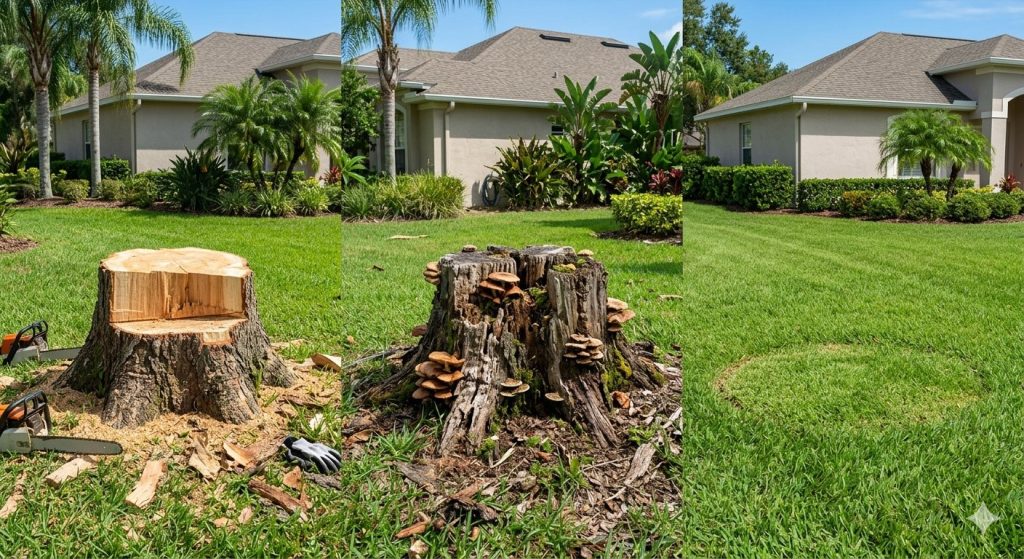
Tree stump decompose time Florida is one of the most common questions homeowners ask after a tree comes down. If you leave a tree stump behind, you will naturally wonder exactly how long it sits there before disappearing completely. The honest answer: longer than most people expect — and our warm, humid Florida climate speeds up decay but also brings serious side effects you should know about.
Natural Decomposition Timeline — Without Any Help
Left entirely alone, the tree stump decompose time in Florida follows this general schedule based on size and wood type:
| Stump Size | Softwood (Pine, Cypress) | Hardwood (Oak, Maple, Magnolia) |
|---|---|---|
| Under 12 inches | 3 – 5 years | 5 – 8 years |
| 12 – 24 inches | 5 – 8 years | 8 – 12 years |
| Over 24 inches | 8 – 12+ years | 12 – 20+ years |
As you can see, tree stump decompose time Florida is measured in years — sometimes decades — not months. A large live oak stump can occupy your yard for 15 to 20 years before it finally breaks down completely. During that entire period, it takes up space, attracts pests, and settles unevenly into your lawn.
What Affects Decomposition Speed?
Several factors determine exactly how long does a tree stump take to decompose in Florida:
Tree Species & Wood Density
Softwood species like pine and cypress rot 30–50% faster than dense hardwoods such as live oak and magnolia. The harder the wood, the slower bacteria and fungi can break it down — and Florida’s most common long-lived shade trees are also the slowest to decompose. This is why tree stump decompose time Florida varies so widely from property to property.
Moisture & Rainfall
Our wet season supports rapid fungal growth — good for breakdown, bad for your yard. Constant moisture means mushrooms, shelf fungi, and slime molds appear annually. These organisms shorten tree stump decompose time Florida but also signal that the stump is becoming a damp, pest-friendly environment.
Soil Conditions & Microbes
Sandy soil drains fast and slows decay. Rich, organic loam holds moisture and speeds it. If the stump sits in full sun, it dries out and takes longer; in shade, it stays damp and rots faster — but also attracts more pests.
What Happens While It Decomposes — The Side Effects
Knowing the tree stump decompose time in Florida matters less than knowing what happens during those years:
- 🐜 Pest habitat — Termites, carpenter ants, beetles, and rodents move in as wood softens, spreading to nearby plants or your home
- 🌱 Sprouting — Shoots emerge annually, trying to regrow the tree; you trim them, they return stronger
- 🕳️ Settling ground — As wood vanishes, the surface sinks, creating holes and uneven lawn
- 🍄 Fungal growth — Mushrooms and conks appear; some are toxic to children and pets
- 🌿 Nutrient robbery — The decaying mass absorbs nitrogen, starving nearby grass and plants
How to Speed Up Decomposition — 3 Methods
If you still prefer to wait, here are proven ways to shorten the tree stump decompose time Florida:
Method 1: Mechanical Accelerating
Drill deep holes 6–12 inches apart into the stump surface and sides. Fill them with water or nitrogen-rich fertilizer every 2–4 weeks. This feeds microbes and can cut decomposition time roughly in half — but it still takes 2–6 years.
Method 2: Chemical Accelerators
Commercial stump removers contain potassium nitrate to speed rotting. Follow instructions carefully — drill holes, add granules, water, wait. Effective but slow: expect 1–3 years for visible results. Keep children and pets away during treatment.
Method 3: Stump Grinding — Fastest by Far
Grinding removes the problem in one afternoon, not years. The machine shaves the stump 6–12 inches below ground, turning it into harmless mulch. The space is ready for sod, planting, or paving immediately. This is the only method that truly eliminates tree stump decompose time Florida entirely — no waiting required.
Compare costs and options in our guide on stump grinding pricing and grinding vs removal.
Professional Recommendation
Waiting out the tree stump decompose time Florida is rarely worth it. The years of pests, uneven ground, and repeated sprouting cost you time and effort that far exceeds the price of professional removal. For authoritative standards, visit the Arbor Day Foundation.
Conclusion
Average tree stump decompose time Florida is 3–8 years for small stumps and 10–20+ years for large hardwoods. Chemical or mechanical methods can shorten this but still take years. Stump grinding finishes the job in hours and leaves your yard ready to use immediately. Don’t wait a decade — reclaim your space today.
Ready to remove that stump? Contact Florida Tree Connect for a free quote and let us help you get your yard back!
