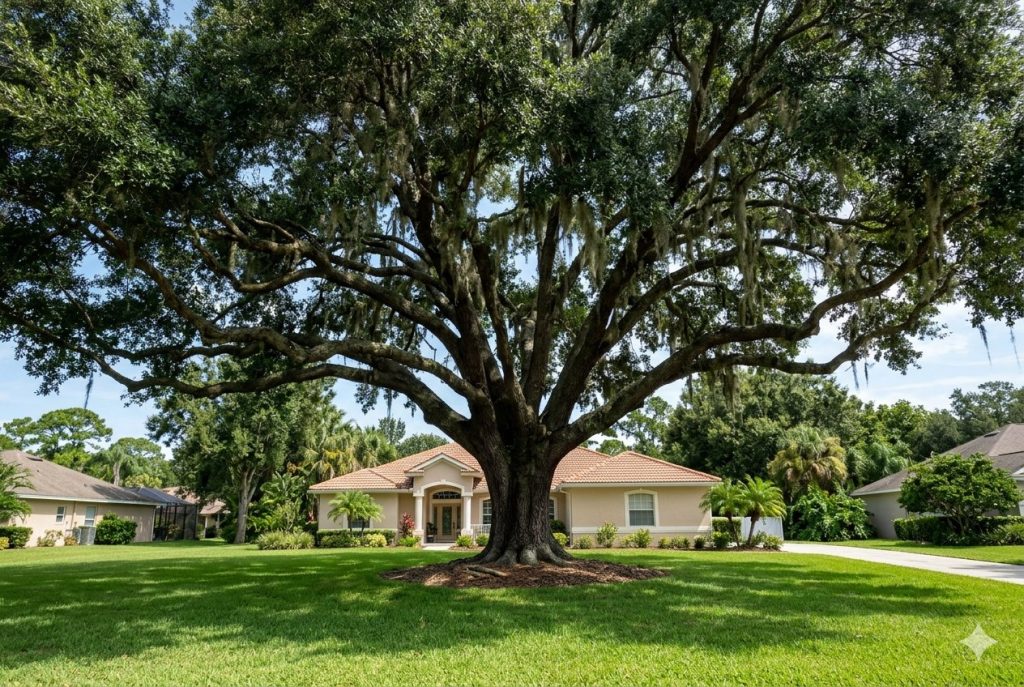
A mature oak can shade a home, shape a yard, and become part of a neighborhood’s character. Keeping it healthy takes more than an occasional trim. Good oak tree care Florida homeowners can put into practice starts with identifying the tree, protecting its roots, and making pruning decisions for a clear reason.
Young and mature oaks need different approaches. A young tree may benefit from planned structural training, while an established oak may need very little pruning. Removing more branches is not automatically better care, and no pruning method makes a tree hurricane-proof.
This guide covers practical maintenance, questions to ask before authorizing work, and preparation before storms. For homeowners in Wesley Chapel and nearby Pasco County communities, the aim is to preserve useful shade while recognizing when professional help is needed.
 ]
Start With the Oak Species and Its Growing Space
Florida has several oak species with different growth habits and site needs. Do not assume that every oak in the neighborhood should receive identical treatment. The UF/IFAS guide to Florida oaks is a useful introduction to those differences.
Record the tree’s approximate size, surrounding buildings, overhead utilities, and recent changes to the landscape. If identification is uncertain, ask a qualified arborist or your county Extension office for help before building a maintenance plan.
Use the tree’s condition as well as its calendar. A large, established oak should not be reshaped simply because a contractor offers annual trimming. Ask what specific problem each proposed task addresses.
Plan Oak Tree Pruning Around a Clear Objective
For young trees, structural pruning guides the development of a durable framework. For mature trees, the objective may be removing dead or damaged branches, addressing a particular defect, or maintaining suitable clearance. An arborist should explain which branches need attention and why.
UF/IFAS notes that young trees may need structural pruning more often than mature trees. That is different from giving every oak a heavy trim each year.
Avoid topping: cutting the crown back indiscriminately to stubs. Also question proposals to strip out healthy interior branches just to make the canopy look empty. Ask for selective work that preserves the tree’s natural form.
There is no single pruning month that fits every oak, condition, and Florida location. Discuss routine timing with the professional inspecting your tree. Broken or dangerous limbs need prompt assessment, while planned maintenance should be arranged well before storm preparations become urgent.
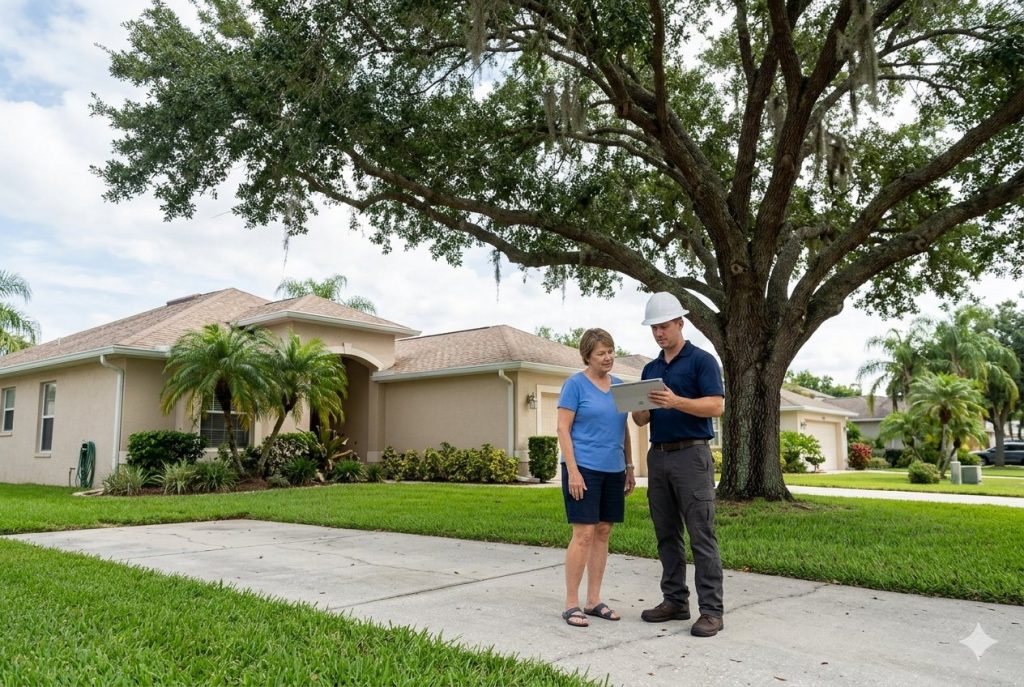
Request a written scope identifying the objective, intended work, and debris removal. Large branches, elevated work, and work near buildings or utilities belong with appropriately qualified professionals, not a homeowner on a ladder.
Protect Roots and Support Everyday Tree Health
Root protection is a central part of oak tree care in Florida. Avoid parking vehicles beneath the canopy, trenching through roots, or adding soil around the trunk without professional advice. UF/IFAS guidance on live oaks emphasizes that root disturbance can cause lasting damage.
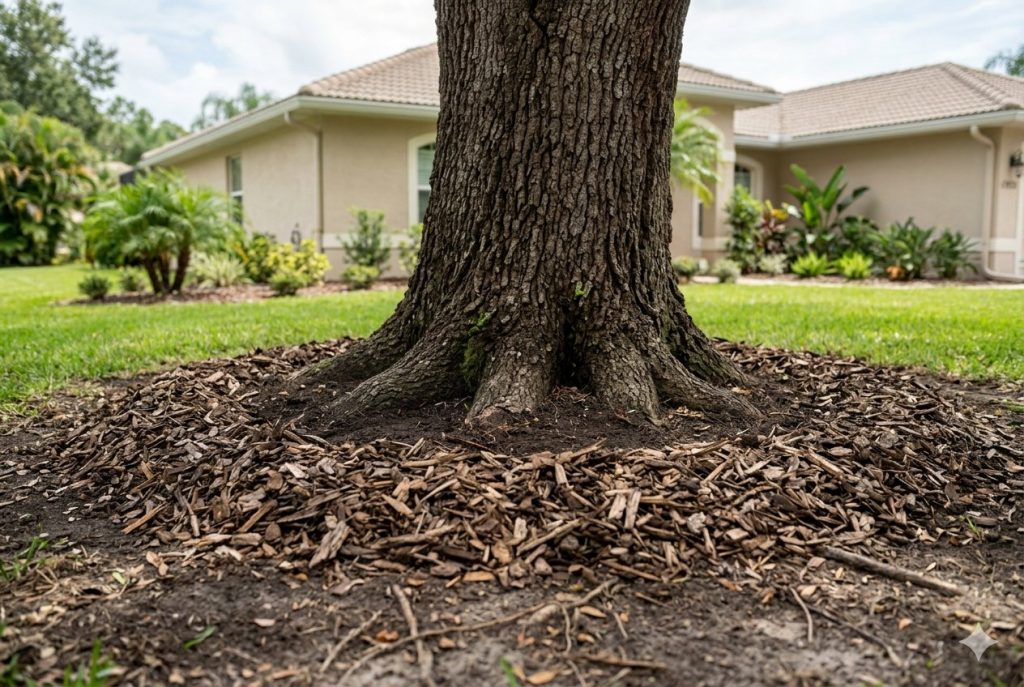
Maintain an organic mulch layer about 2 to 3 inches deep, keeping it away from the trunk. Do not build a mulch mound against the bark or keep adding layers without checking the existing depth. See UF/IFAS tree maintenance guidance for mulching principles.
Watering should reflect species, establishment stage, soil moisture, and drainage. Do not treat an established live oak like a newly planted tree or assume more irrigation is always helpful. Ask whether fertilizer is needed before applying it, rather than treating it as an automatic annual service.
Keep a simple record of canopy changes, dead branches, trunk damage, and nearby construction. Photographs taken safely from the same viewpoint can make your next discussion with an arborist more useful.
Prepare Your Oak Before Storms Become Imminent
Arrange an assessment early enough to evaluate concerns, agree on a scope, and remove resulting debris. UF/IFAS hurricane preparation guidance emphasizes sound structure and appropriate pruning. Preparation reduces some risks; it does not guarantee survival.
| When | Practical action |
|---|---|
| During routine maintenance planning | Discuss branch structure, clearance, root protection, and any changes since the previous inspection. |
| Well before a storm threatens | Complete agreed professional work and arrange removal of branches and brush. |
| As severe weather approaches | Follow official safety guidance; do not begin tree work in dangerous weather. |
| After conditions are safe | Observe from a distance and request professional help for hanging limbs, splits, or new leaning. |
After storm damage, do not assume leaf loss alone means an oak must be removed. Equally, a green canopy does not establish that the tree is stable. The UF/IFAS restoration guide distinguishes immediate risk reduction from longer-term recovery and advises conserving live wood during initial cleanup.
Keep away from trees or branches touching power lines and contact the electric utility. For an immediate threat to life, contact emergency services. Do not use a website inquiry as an emergency response channel.
 ]
Frequently Asked Questions About Oak Tree Care
Does a mature oak need pruning every year?
Not automatically. Pruning frequency depends on structure, condition, previous work, and surrounding targets. Ask for an inspection-based recommendation instead of a fixed heavy-trimming schedule.
Should I cut exposed oak roots to protect a driveway?
Do not cut substantial roots without professional evaluation. Ask an arborist and the relevant property professional to review options that account for both the tree and the paved surface.
Can pruning make an oak hurricane-proof?
No. Appropriate maintenance can address some defects, but severe weather can damage healthy trees. Avoid any promise of guaranteed storm protection.
Should I fertilize an oak after a storm?
Do not apply fertilizer automatically. Ask what problem has been identified and whether treatment is justified. Recovery planning should reflect the tree’s damage and growing conditions.
Discuss Oak Tree Care in Wesley Chapel
Planning oak tree care in Florida starts with a clear description of your tree and concerns. In Wesley Chapel or nearby Pasco County, email hello@floridatreeconnect.com with your city, ZIP code, and photographs taken safely.
Florida Tree Connect is a referral service. We review requests and may help connect you with an independent provider, subject to availability. Confirm qualifications, insurance, assessment scope, pricing, and scheduling directly with the provider. An inquiry does not guarantee a match or response time.
